Toronto → Bangkok
195 fares observed since Jul 15 · lowest $1,039
When it's cheap to go
Lowest fare we observed per departure date · grey dates: not enough data yet — we never guess. Swatches: lower · neutral · higher (not buttons).
Live finds
Opens Aviasales — the partner sets the final price. Affiliate link: if you complete an eligible booking we may receive a commission. It never changes your price.
♡ Watch this route
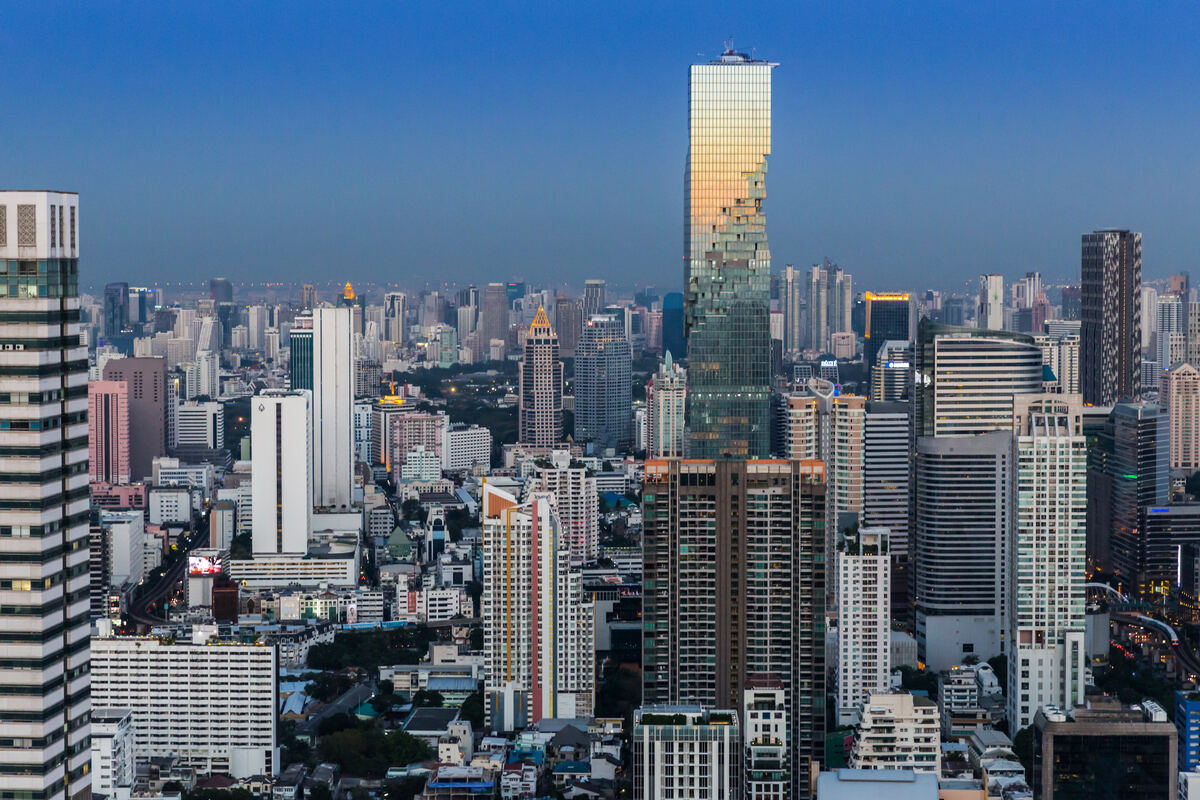
Bangkok route guide
There is no nonstop between Toronto Pearson (YYZ) and Bangkok Suvarnabhumi (BKK) as of mid-2026, so this route is really a decision about where to connect: over an East Asian hub, over the Gulf, or across Canada to Vancouver's Bangkok nonstop. Well-timed one-stop itineraries have typically run about 20 to 24 hours each way, so the choice of hub matters more here than on shorter routes. This guide covers who has flown it, when Thailand's seasons work in your favour, and what to expect when you land.
Airlines on this route
As of July 2026, no airline flies nonstop between Toronto Pearson and Bangkok Suvarnabhumi — the only nonstop between North America and Thailand is Air Canada's Vancouver–Bangkok service, which has operated year-round since October 28, 2025. From Toronto, the established one-stop patterns run over East Asian hubs — Cathay Pacific via Hong Kong, EVA Air via Taipei, Korean Air via Seoul — or over the Gulf, with Emirates via Dubai and Etihad Airways via Abu Dhabi; Air China, China Eastern, Turkish Airlines and Thai Airways (as an onward carrier) also appear in connecting itineraries. Air Canada sells a single-carrier routing as well: Toronto–Vancouver plus its Bangkok nonstop, marketed with same-day connections. One caveat: Gulf-hub routings have seen conflict-related disruption since March 2026, so re-check schedules for those before committing.
| Airline | Code | Service (as of July 2026) |
|---|---|---|
| Air Canada | AC | one-stop via Vancouver; the Vancouver–Bangkok nonstop has operated year-round since October 28, 2025 |
| Cathay Pacific | CX | one-stop via Hong Kong; aggregator data as of mid-2026 suggested this is the highest-frequency connecting option, at roughly 60 connections a week |
| EVA Air | BR | one-stop via Taipei–Taoyuan |
| Korean Air | KE | one-stop via Seoul–Incheon |
| Emirates | EK | one-stop via Dubai; has seen conflict-related disruption since March 2026 — re-check schedules close to travel |
| Etihad Airways | EY | one-stop via Abu Dhabi; still rebuilding capacity after early-2026 disruption — re-check schedules close to travel |
When to go
Thailand's government portal splits the year into three seasons: a hot season from mid-February to mid-May (afternoons of 35–39°C are normal), a rainy season from mid-May to mid-October under the southwest monsoon, and a cooler, drier "winter" from mid-October to mid-February. That cool window — roughly November through February — is Thailand's peak tourist season, typically drier and clearer, and demand from Canada has historically followed it; June through October is the quieter green season, with travel-guide sources noting travel costs are often lower then. Southern Thailand runs on its own rain clock: the same portal notes the South keeps getting heavy rain until December, which matters for the Gulf islands around Koh Samui even after Bangkok has dried out. Songkran, the Thai New Year water festival and the country's biggest holiday, is officially observed April 13–15 (all three are public holidays in 2026) — expect heavy domestic travel, full flights and multi-day street celebrations, including the government-backed water festival events in Bangkok. These are historical patterns, not forecasts; any given week can break them.
Arrival and practicalities
The Airport Rail Link City Line runs from the basement level of the passenger terminal to Phaya Thai in central Bangkok in roughly 26–30 minutes. As of mid-2026 the one-way fare has been about 45 baht, with trains every 10–15 minutes from about 05:30 to midnight; Phaya Thai connects to the BTS Skytrain and Makkasan to the MRT. The operator has been in transition, so fares and hours are worth a re-check close to travel.
Long-haul arrivals at Suvarnabhumi may dock at SAT-1, the satellite concourse that opened in September 2023 and lifted the airport's capacity from 45 to 60 million passengers a year. It sits about a kilometre from the main terminal, linked by an underground automated people mover that takes roughly three minutes including the wait — budget a little extra time between gate and immigration or baggage.
Bangkok has two airports. Suvarnabhumi (BKK) handles the full-service international carriers you arrive on from Toronto; Don Mueang (DMK), across town, is the main low-cost-carrier base. If you have an onward budget hop within Thailand or Southeast Asia, check which airport it leaves from — moving between the two is a cross-town transfer, not a terminal change.
Questions travelers ask
- Is there a nonstop flight from Toronto to Bangkok?
- No — as of mid-2026, every Toronto Pearson to Bangkok itinerary involves at least one stop. The only nonstop between North America and Thailand departs Vancouver: Air Canada's Vancouver–Bangkok service, which has operated year-round since October 28, 2025. Air Canada sells it from Toronto as a through-itinerary with a domestic connection.
- How long does the trip take?
- Based on schedule data as of mid-2026, the fastest one-stop itineraries have run roughly 19.5 to 21 hours, and typical well-timed connections about 20 to 24 hours each way. Routing via Vancouver means a roughly five-hour domestic flight plus connection time ahead of a nonstop segment scheduled at about 13 to 16 hours.
- Do Canadians need a visa for Thailand?
- Per the Government of Canada's Thailand travel advice (updated July 7, 2026), no tourist visa is required for stays of up to 60 days, extendable by around 30 days at Thai immigration offices. Your passport must be valid at least six months on entry, and border officials may ask for a return or onward ticket and proof of sufficient funds — entry can be denied without them. Entry rules change; re-check travel.gc.ca before you fly.
- What is the Thailand Digital Arrival Card (TDAC)?
- A free online form that all foreign travellers, Canadians included, must complete before arrival — the portal is tdac.immigration.go.th, and it can be submitted within three days of arrival. It replaced the paper TM6 form and has been mandatory for all air, land and sea entries since May 1, 2025.
- What is the time difference between Toronto and Bangkok?
- Bangkok is on Indochina Time, UTC+7 year-round with no daylight saving — 11 hours ahead of Toronto in summer and 12 hours ahead in winter. With a typical evening departure from Pearson, you land roughly two calendar days after you left.
- When is it cheapest to fly this route?
- We don't make fare predictions in editorial — the price observations on this page show what we've actually recorded. What has been consistent is the demand pattern: crowds peak in the cool November–February season, over Christmas and New Year, and around Songkran in mid-April, while June–October is the rainy low season, when travel-guide sources note costs are often lower. Weigh that against the season itself: rainy-season travel typically means afternoon monsoon showers.
Sources
- Open Jaw — Air Canada summer 2026 network expansion
- Air Canada press release (Thailand4 reprint) — Vancouver–Bangkok goes year-round
- TAT Newsroom — Air Canada's Vancouver–Bangkok launch (Dec 2022)
- Wikipedia — Toronto Pearson airlines and destinations
- Flightroutes.com — YYZ–BKK route summary
- Cathay Pacific — Toronto to Bangkok route page
- BNN Bloomberg — airlines cancelling flights amid the Middle East conflict
- Royal Thai Government — The Seasons of Thailand
- Responsible Travel — when to visit Thailand
- Thai Rath — Thailand's 2026 public holiday calendar
- Bangkok Airport Train — Airport Rail Link guide
- TAT Newsroom — Suvarnabhumi SAT-1 terminal opening (Sept 2023)
- Expedia — Toronto to Don Mueang route page
- Government of Canada — Thailand travel advice
- US Embassy Bangkok — Thailand Digital Arrival Card launch notice
- Greenwich Mean Time — Bangkok time zone
Guide reviewed July 14, 2026. Airline schedules and entry rules change — always confirm with the official source before booking.